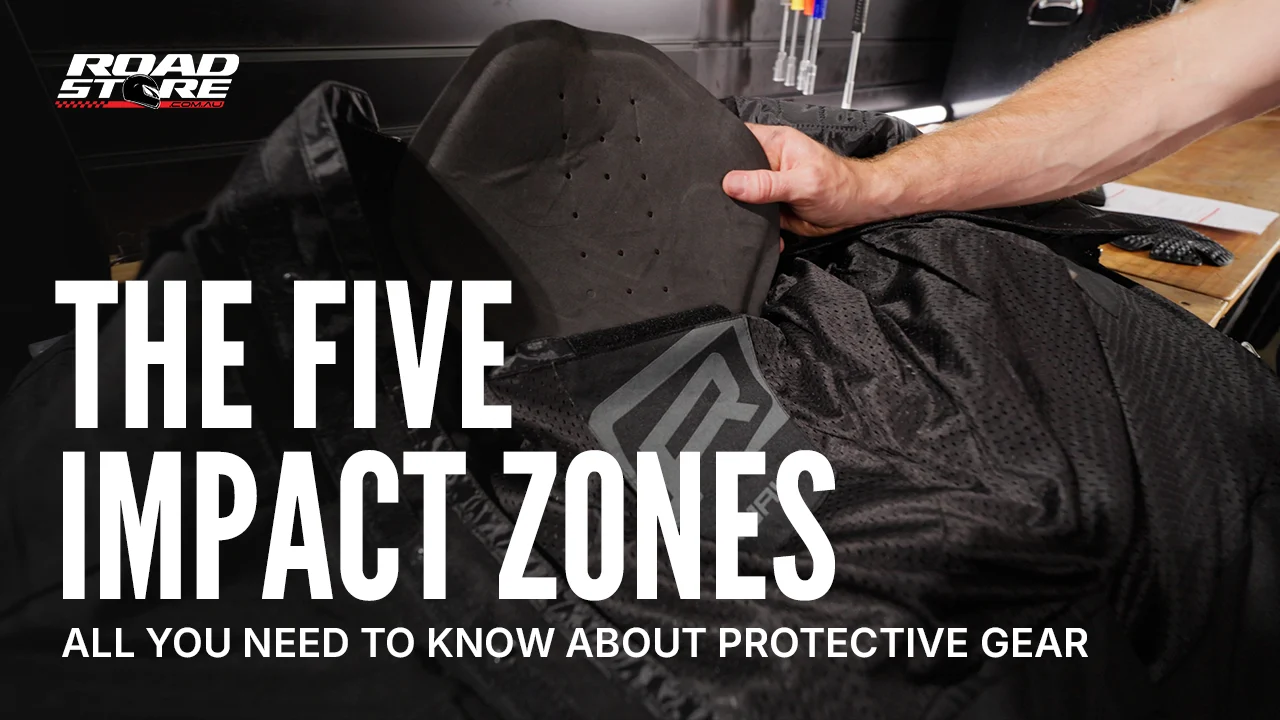
There is probably armour inside the motorcycle jacket you already own. Here is what the CE rating on it actually means, where the protection matters most, and the one piece worth upgrading first.
Most riders buy a jacket, wear it for three years and never once take the armour out of it. Which is a shame, because the armour is the part doing the actual impact protection. It is also the part you can change without buying a new jacket.
You will normally see two ratings on motorcycle body armour: CE Level 1 and CE Level 2. This guide explains what those mean, which zones are worth protecting, and what to prioritise if you are building your setup gradually rather than all at once.
CE Level 1 vs Level 2: what the rating actually means
The CE rating is printed directly on the protector. Pull a shoulder or back insert out of your jacket and you will find it moulded or heat-stamped into the piece, along with the standard it was tested to.
Both levels are tested the same way. The protector is struck with a controlled impact, and the force that transfers through it to the other side is measured. The lower that transmitted force, the better the armour has done its job.
| Max force | Rating | What it means |
|---|---|---|
| 35 kN | CE Level 1 Limb, EN 1621-1 |
Certified motorcycle protection. Thinner, more flexible and more comfortable, and what most jackets ship with as standard. |
| 20 kN | CE Level 2 Limb, EN 1621-1 |
Roughly 40% less force through to you in the same test. The trade-off is usually a little more bulk, weight or stiffness. |
| 18 kN | CE Level 1 Back, EN 1621-2 |
Back protectors are tested to a separate standard with tighter limits than limb armour. |
| 9 kN | CE Level 2 Back, EN 1621-2 |
Half the transmitted force of a Level 1 back protector. The strictest rating in this guide. |
So the simple version: Level 2 lets significantly less force through than Level 1.
But it is worth being clear about the other half of that. Level 1 is not bad armour. It is still certified motorcycle protection that has passed a real impact test. Level 2 simply provides a higher level of impact attenuation, and it usually costs something in thickness, weight or flexibility to get there.
That gap is narrowing fast. Modern soft armour (the D3O, Rheon and similar materials that stay flexible when you move and stiffen on impact) now hits Level 2 in packages that are not much thicker than the Level 1 foam they replace. If the reason you have avoided Level 2 is that you tried a rigid plastic back plate a decade ago, it is worth another look.
Watch here for more
The five main impact zones
When we talk about motorcycle body armour, there are five areas we are trying to protect.
| Zone | What to know |
|---|---|
| Shoulders | First point of contact in most low-side and high-side crashes. Nearly always fitted as standard in a riding jacket. |
| Elbows | The instinctive thing you put out to break a fall. Also standard in most jackets, and cheap to upgrade. |
| Back | The one most often missing. This is where the foam versus certified problem lives. More on that below. |
| Hips | Pants and riding jeans territory. Frequently sold as an optional insert rather than fitted in the box. |
| Knees | High contact, high consequence. Worth checking that the pocket lets you set the height correctly for your leg. |
Here is the thing a lot of riders do not realise. Plenty of jackets come with proper certified shoulder and elbow protectors, but the back of the jacket has a piece of plain foam sitting in the pocket instead.
That foam is a placeholder. It gives the jacket its shape and fills the pocket so the jacket hangs correctly on the rack. It is not the same thing as a certified back protector, and it will not carry a CE marking, because it has not been tested to one.
How a back protector should fit
A back protector does not just need to cover your back. It needs to stay in the right place while you are moving and, more importantly, while you are sliding.
| Check | What to look for |
|---|---|
| Yes | Coverage from the base of the neck down toward the lower ribs. That is the span you are trying to protect. Sizing is usually by torso length rather than shirt size, so check the brand's chart rather than guessing. |
| No | Not pushed so high that it interferes with the helmet. If it is fouling the base of your lid when you look up, it is sitting too high, and it is leaving your lower back uncovered at the same time. |
| No | Not loose. Strap it up, then twist your upper body. If the protector slides around independently of you, it is too loose to be where it needs to be when you need it. |
| Yes | Snug enough that the armour moves with you. That is the test. Twist, shrug, reach for the bars. The protector should track your body, not swim inside the jacket. |
Same principle applies to insert-style protectors that live in the jacket's back pocket. If the pocket is oversized for the insert, the armour will migrate, and a back protector sitting sideways across your kidneys is not protecting your spine.
Armoured hoodie vs motorcycle jacket
So where does an armoured hoodie sit in all this? Are they actually safe?
The honest answer is that they are a massive improvement over riding around in a normal jumper, but they are still not the same thing as a full motorcycle jacket.
| Armoured hoodie | Motorcycle jacket | |
|---|---|---|
| Impact armour | Yes. CE protectors at shoulders and elbows, back pocket usually included. | Yes. Same protectors, often with a certified back protector fitted. |
| Abrasion | Aramid or Kevlar lining through the main panels. | Purpose-built outer shell, leather or heavy textile. |
| Weather | Limited. No waterproof membrane, no thermal liner. | Waterproofing, venting and liners depending on the model. |
| Best for | Town commuting, short runs, anywhere you would otherwise wear a jumper. | Highway, touring, higher-speed riding, all weather. |
What you generally sacrifice with a hoodie is weather protection, outer-shell strength and sometimes coverage. What you gain is something you will actually put on for a ten-minute ride across town.
So if you are commuting around town and the realistic alternative is a plain cotton hoodie, an armoured one makes a lot of sense. If you are regularly doing highway kilometres, touring or higher-speed riding, move toward a proper motorcycle jacket.
What should you buy first?
If you are building your protection setup gradually, you do not need to buy everything today. Work down this list in order.
Upgrade order
- A proper back protector. Biggest single gain, because it is the zone most likely to be foam right now. Check the pocket in your jacket first. An insert is cheaper than a strap-on unit and disappears into the jacket you already wear.
- Shoulder and elbow armour. Already in the jacket, so this is a straight Level 1 to Level 2 swap. Check the shape and size code on the existing piece and match it.
- Hip and knee armour. Often the optional extra in riding jeans and pants. Worth confirming yours actually came with them fitted, not just with the pockets.
- Chest protection. Depends on your riding. Track days, aggressive road riding and higher-speed riding are where the extra protection starts making real sense.
One practical note on swapping inserts: armour is not universal. Protectors come in different shapes and sizes to suit different pockets, so check the dimensions of what is currently in your jacket before ordering a replacement. If you are not sure, send us the jacket model and we will tell you what fits.
Common questions about motorcycle armour
Is CE Level 2 armour better than Level 1?
Level 2 transmits less impact force in the certification test: a maximum mean of 20 kN versus 35 kN for limb armour, and 9 kN versus 18 kN for back protectors. So yes, it offers more impact protection. It can be slightly thicker, heavier or stiffer in return, though modern soft armour has narrowed that gap considerably. Level 1 is still certified protection and is a perfectly reasonable choice for lower-speed riding.
How do I know if my jacket has a real back protector?
Take it out of the back pocket and look at it. A certified back protector carries a CE marking and a reference to EN 1621-2, along with its level. If the piece is plain foam with no markings at all, it is a placeholder that gives the jacket its shape, not a protector.
What CE level should a back protector be?
Level 2 where you can. The back is the zone with the least tolerance for a hit and the standard is stricter there for that reason. If the only Level 2 option will not sit properly in your jacket's pocket, a well-fitted Level 1 beats a Level 2 that moves around.
Are armoured hoodies safe for motorcycle riding?
They are a significant step up from a normal jumper. You get CE impact armour and an abrasion-resistant lining. They are not equivalent to a full motorcycle jacket, which has a stronger outer shell and proper weather protection. They suit town commuting; for highway and touring, choose a jacket.
Can I upgrade the armour in a jacket I already own?
In most cases, yes. Riding jackets use pocketed inserts, so you can swap Level 1 protectors for Level 2 and fit a certified back protector where there is currently foam. Check the size and shape of the existing insert first, as armour is not a universal fit.
Does motorcycle armour expire?
There is no fixed expiry date, but armour is a one-crash item. If a protector has taken a real impact, replace it. Soft armour also hardens and degrades over years of heat cycling in a jacket left in the sun, so if yours is a decade old and feels different to how you remember, it is worth replacing.
Start with the jacket you have already got
Have a look inside the jacket hanging in your garage. Take the armour out. Check the CE markings on each piece.
You might find you already have decent protection. Or you might discover there is still a piece of plain foam sitting in the back pocket. Either way, you will know what you are actually wearing. That is the part most riders never check.
Shop armour inserts and back protectors
CE Level 1 and Level 2 protectors for shoulders, elbows, back, hips and knees. Not sure what fits your jacket? Send us the model and we will check.
Browse armour inserts